A B2B partnership is a strategic collaboration between two or more non-competing businesses that share a target audience to drive mutual growth, share resources, and build instant market trust.
Referral & Affiliate Partners: Companies recommend each other's services or products in exchange for a commission or reciprocal lead.
Resellers & Channel Partners: One business sells another company's product or software, adding margin or earning a direct percentage of sales.
Technology & Integration Alliances: Tech platforms integrate their software offerings to provide a combined, seamless solution for shared users.
Strategic Alliances & Joint Ventures: Companies pool deeper financial resources, expertise, or legal ownership for massive projects or new market entry.
Technology Integrations: Merging distinct software systems (e.g., embedding contract software into cloud suites) to provide an all-in-one product experience.
Co-Marketing & Co-Branding: Launching collaborative marketing campaigns or joint products to capture a shared audience base.
Channel & Reseller Alliances: Handing over or extending your sales motion to third-party providers or agencies who sell your product with their services.
Referral & Affiliate Networks: Formalized performance-driven frameworks where businesses introduce vetted specialists to clients in exchange for payouts or mutual goodwill.
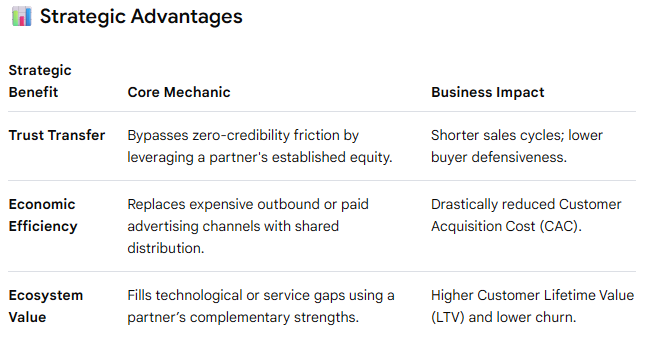
Trust Transfer: Bypasses the slow process of building brand credibility by aligning with a brand your audience already trusts.
Lower Customer Acquisition Cost (CAC): Reduces reliance on expensive, saturated paid media channels.
Shared Distribution: Opens doors to new geographic markets or client bases without starting from zero.
A Buisness to Buisness (B2B) partnership is a strategic collaboration between two or more companies that combine resources, expertise, or customer bases to achieve mutual growth without directly competing. In a market increasingly defined by buyer skepticism and rising customer acquisition costs, alliances serve as a structural infrastructure to transfer brand credibility, scale distribution, and shorten the sales cycle. You make It, I will package it( Ideal partnership for B2B in Production 📋 The 4-Step Framework for Success
According to modern ecosystem playbooks like The B2B Playbook, successful partnerships require a structured operating model rather than opportunistic networking:
Define Your Ideal Partner Profile (IPP): Target non-competing businesses that share overlapping firmographics and serve identical Ideal Customer Profiles (ICPs).
Shortlist Aligned Targets:Focus intently on 3 to 5 key strategic partners rather than spreading resources too thin.
Draft a Clear "Give/Get" Model: Map out exactly what each party brings to the table and how value flows—whether via direct margin, tech data sharing, or lead exchanges.
Initiate KPI-Focused Outreach: Launch interactions backed by explicit metrics, shared pipeline data, and strict attribution tracking to avoid relationship erosion.





Comments (0)
No comments yet. Be the first to share your thoughts.