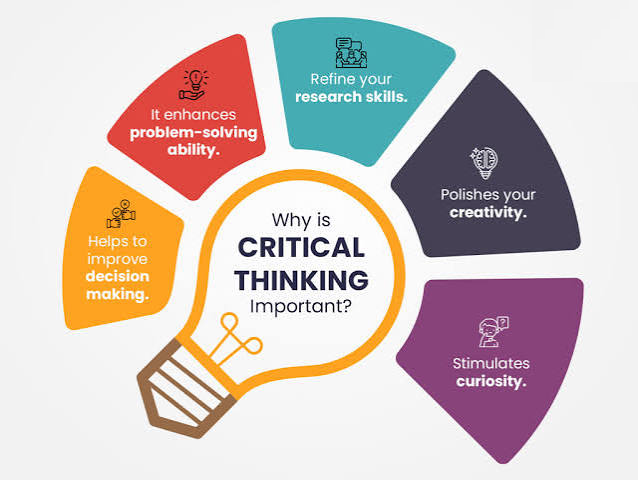
Critical thinking is a foundational cognitive framework that allows individuals to analyze information objectively, evaluate evidence, and make reasoned judgments. Building a mindset that is "built to endure" complex problems and the noise of modern misinformation requires structured habits rather than relying on pure intuition.
Curiosity: This pushes you to ask deep questions, seek new facts, and avoid taking information at face value.
Criticality: This helps you evaluate arguments, check sources for truth, and spot logical flaws or hidden biases.
Creativity: This allows you to build alternative approaches and find smart, new answers to hard problems.
🛠️ Daily Habits for Mental Endurance
Opposition View point : Instead of attacking a weak version of an opposing view, build the strongest possible version of it. If your logic can still hold up against their best argument, your conclusion is resilient.
Identify the Genre and Intent: When consuming media, always verify what you are looking at. Ask yourself if an article is objective news, a opinion piece, or a hidden advertisement.
Examine Hidden Assumptions: Question things taken for granted. Identify what biases or automatic leaps in logic you or others are making before accepting data as a fact.
The "child" Rule: if you can't explain it well to a child then you don't understand it well enough. Try to explain a highly complex problem or concept using simple, universal language. If you cannot simplify it without losing its core truth, you do not fully understand it yet.

Comments (0)
No comments yet. Be the first to share your thoughts.