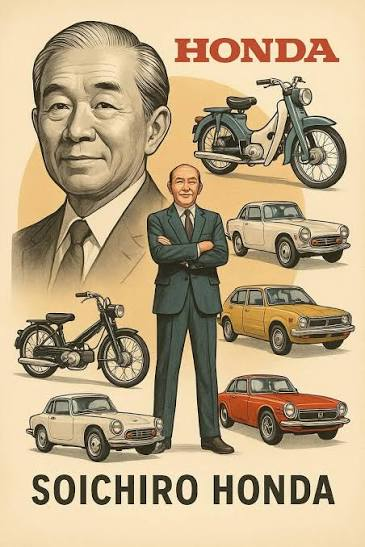
Born in 1906 in a small Japanese village, Soichiro was the son of a blacksmith.
An encounter with a Ford Model T at age eight ignited his lifelong love for engines.
At age 15, he moved to Tokyo and started working at an auto-repair shop called Art Shokai.
He learned mechanical repairs, built racing cars, and eventually ran his own branch in Hamamatsu.
Overcoming Rejection and Disaster
In the 1930s, he started Tokai Seiki to manufacture piston rings and pitched them to Toyota.
Toyota initially rejected his designs for poor quality, prompting Soichiro to study metallurgy in school and improve his work until Toyota accepted them.
During World War II, his factories suffered severe damage from bombings and an earthquake.
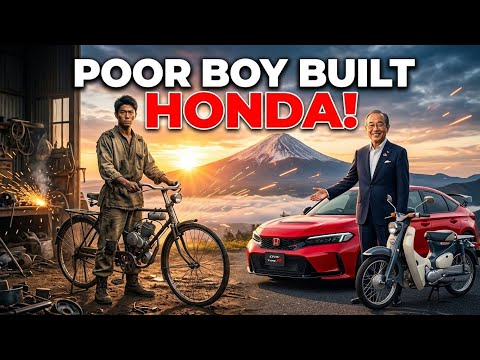
From nothing to Something Built to Endure: Honda, How a Poor Japanese Boy Created Honda tells the story of Soichiro Honda, a boy who grew up in postwar Japan with limited means but an intense drive to understand how machines worked. After leaving school early, he pursued engineering through practical work and self-directed learning, first repairing and tinkering with engines and then building a reputation for mechanical ingenuity. In the 1930s he began experimenting with small engines and racing motorcycles, using competition as both a proving ground and a laboratory for reliability, performance, and design improvements. During World War II, Honda’s early efforts were constrained by wartime conditions, but the experience sharpened his focus on engineering discipline and durable construction. After the war, Honda founded Honda Motor Company and shifted from tinkering to manufacturing, aiming to produce motorcycles that were dependable for ordinary people and adaptable to Japan’s rebuilding economy. The company’s breakthrough came from refining engine technology, improving materials and tolerances, and applying rigorous testing so that bikes could withstand real-world use rather than just perform briefly. As Honda expanded, it kept emphasizing craftsmanship and continuous improvement, turning a personal obsession with engines into an industrial approach that scaled. By the time Honda became a major global manufacturer, the core idea remained consistent: build machines that endure, supported by relentless problem-solving, practical design, and a willingness to learn from failures.
1. Two critical childhood moments defined his path:
The Smell of Oil: As a small boy, he saw a Ford Model T roll through his village. He was so captivated by the machine that he ran after it, knelt down, and rubbed the oil that dripped onto the ground onto his hands, dreaming of engines ever since.
The Airplane Pilot: At age 8, he stole his father's bicycle and rode 20 miles just to see a stunt pilot perform. This cemented his lifelong obsession with speed and engineering.
At just 15 years old, with no formal technical education, Soichiro left home for Tokyo to work as an apprentice at a car repair shop called Art Shokai.
2. From Scrapyard Pistons to War-Torn Ruins
Honda’s path was never smooth. He was a brilliant mechanic but an unconventional businessman.
The Piston Ring Failure: In 1937, he founded Tokai Seiki to manufacture piston rings for Toyota. Despite working day and night, his first batches were rejected by Toyota because they lacked the proper quality control. Instead of quitting, he went back to school, studied metallurgy, and eventually won the contract.
Devastation: During World War II, a US bombing raid destroyed one of his factories. In 1945, a massive earthquake leveled the other.
The Reset: Left with almost nothing, Honda sold what remained of his piston business to Toyota for 450,000 yen. He spent the next year in a self-described "creative pause," drinking homemade alcohol and reflecting on his next move.
🚲 3. The Bicycle and the "Super Cub" Revolution
In 1946, amidst the ruins of post-war Japan, people desperately needed cheap, efficient transportation. Trains were packed, and fuel was heavily rationed.
The First Breakthrough: Honda found a surplus of small, surplus military generator engines meant for radios. He had a simple idea: mount them onto bicycles.
The Birth of Honda Motor Co.: In 1948, he officially established Honda Motor Co.
with a vision to mobilize the masses.
The Missing Piece: Soichiro was a genius engineer but hated accounting and marketing. In 1949, he partnered with Takeo Fujisawa, a brilliant business strategist. Fujisawa managed the money and the market, while Honda focused strictly on engineering. This partnership became the backbone of the company's survival.
In 1958, they launched the Honda Super Cub. It was cheap, easy to ride, and reliable. It became the best-selling motor vehicle in human history, with over 100 million units sold to date.
🏁 4. "You Meet the Nicest People on a Honda"
In the 1950s and 60s, motorcycles in the West were associated with outlaw biker gangs like the Hells Angels. To break into the American market, Honda completely changed the narrative.
The Ad Campaign: They launched the iconic slogan: "You meet the nicest people on a Honda." It featured everyday citizens—moms, students, professionals—riding the Super Cub.
Racing Dominance: To prove Japanese engineering was superior, Soichiro entered Honda motorcycles into the grueling Isle of Man TT races. By 1961, Honda swept the podium in multiple classes, shocking European manufacturers and establishing global dominance.
🚗 5. Moving to Four Wheels: The Civic and Beyond
Despite opposition from the Japanese government (which wanted Honda to stick to motorcycles and leave cars to Toyota and Nissan), Soichiro pushed into car manufacturing in the 1960s.
The CVCC Engine: In 1972, Honda introduced the Honda Civic. When the US passed strict clean-air laws (the Clean Air Act), Detroit automakers claimed it was impossible to meet the standards without expensive catalytic converters. Honda’s engineers designed the CVCC engine, which burned fuel so cleanly it met the regulations without a converter.
The Global Standard: The 1973 oil crisis hit right as the fuel-efficient Civic hit the market, skyrocketing Honda into a premier global automotive powerhouse.
6. 📉 The Philosophy of Endurance: "Success is 99% Failure"
Soichiro Honda retired from the company in 1973, but his philosophy remains embedded in the brand's DNA. He famously said:
"Success represents the 1% of your work which results from the 99% that is called failure."
Honda was built to endure because its founder viewed every crisis—whether it was poverty, rejected parts, bombings, or natural disasters—as a mechanical problem waiting for a creative solution.
Comments (0)
No comments yet. Be the first to share your thoughts.
Comments (0)
No comments yet. Be the first to share your thoughts.