Nvidia’s philosophy of endurance centers on long-term technological bets, relentless leadership resilience, and engineering infrastructure designed to last.
The narrative of Nvidia is one of the ultimate corporate turnarounds in tech history—a journey famously summarized by co-founder and CEO Jensen Huang as a masterclass in "pain and suffering". Today, Nvidia stands at the pinnacle of the global technology ecosystem, but its path from a Denny's diner booth in 1993 to a multi-trillion-dollar empire was defined by near-extinction events and brutal marketplace lessons. The enduring system
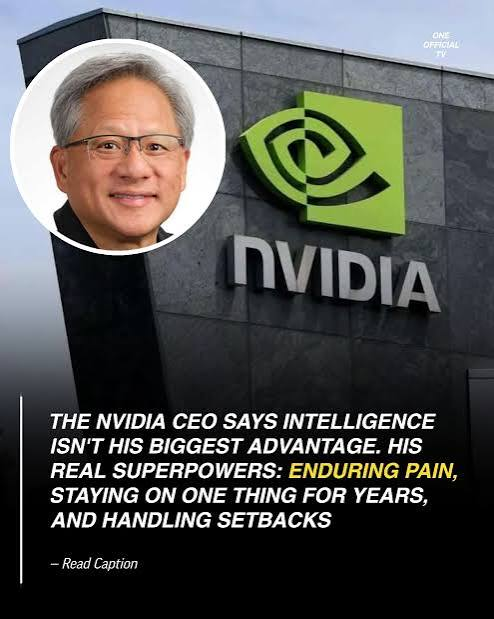
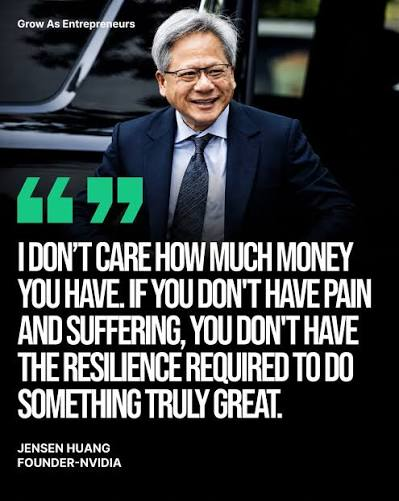
Nvidia CEO Jensen Huang says if you want to be successful, prepare to suffer: ‘If it’s a walk in the park, anybody could do it’
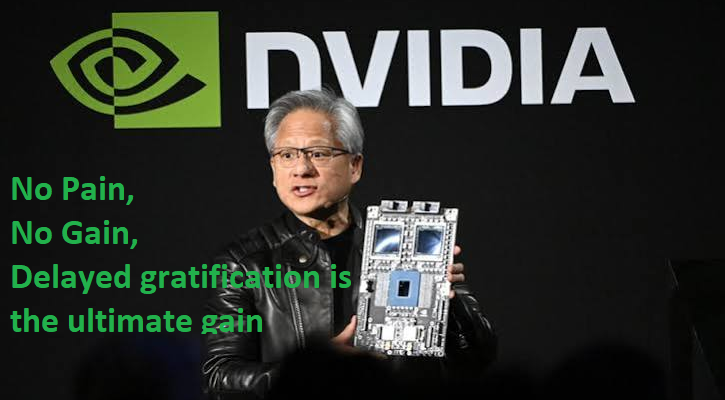
"we must Grow through pain , so that the gain can be truly enduring." (Odeyemi Daniel) Pain is a good teacher, we grow up through the pain that forge our characters - Odeyemi Daniel. Short term gain are not capital gain , delayed gratification is the ultimate gain. The future does not get better by hopes it gets better by plans and actions. Behind every progress, there are consolidated painful experience that purified the Gold.
Pain and Suffering is part of the growth process Nvidia'scorporate philosophy and structural engineering are intentionally "built to endure,"a narrative driven by both its internal management culture and its strategic positioning of physical hardware as long-lasting capital assets
CEO Jensen Huang's leadership mindset and the longevity of its AI data centers are keys to the endurance that propel the exponential growth of Nvidia.
Nvidia’s rise from an idea hatched in a booth at Denny’s to the world’s most valuable company is one of the defining business stories of the AI boom. But according to CEO Jensen Huang, whose net worth now sits at $196 billion, there’s a less glamorous ingredient behind that success: suffering.
Long-Term Bet on CUDA: CEO Jensen Huang invested billions into CUDA when general-purpose GPU computing was mocked by Wall Street and caused Nvidia's valuation to crater, turning graphics chips into the foundational engine of parallel computing and modern AI.
Resilience Through Hardship: Huang frequently emphasizes that enduring as a leader requires embracing pain, suffering, and near-death business moments (such as early technical failures with the NV1 chip and market collapses) rather than seeking immediate comfort.
AI Factory Infrastructure: Nvidia designs its systems—such as the Rubin generation and full liquid-cooling stacks—to be productive, durable, and fungible, maximizing return on investment and extending the operational lifecycle of massive data centers.
Continuous Re-invention: The company routinely pivots its architecture ahead of market shifts, moving from 3D gaming and graphics offloading to deep learning, physics simulation, autonomous vehicles, and sovereign superintelligence investments.
1. Culture: "Suffering" and Engineering Resilience
At the core of Nvidia’s resilience is co-founder and CEO Jensen Huang, who frequently preaches that true success requires an immense tolerance for pain and failure.
The Leadership Philosophy: Huang openly states, "Nobody suffers better than I can," arguing that overcoming setbacks—such as Nvidia's near-bankruptcy in the 1990s and its highly mocked $10 billion gamble on CUDA—is what built the organization's unbreakable foundation.
Flat Organization: Nvidia's internal structure is organized around rapid project execution rather than traditional corporate hierarchies. This allows the team to pivot and ship new architectures—like the upcoming Blackwell Ultra and the Vera Rubin platforms—at a blistering annual cadence.
2. Architecture: The "Enduring Asset Class"
Financially and technologically, Nvidia is making a concerted effort to convince Wall Street that its AI factories are not temporary tech trends, but durable, long-term capital assets. By designing backward-compatible software ecosystems and highly modular hardware stacks, Nvidia ensures that data center operators do not face stranded assets when next-generation chips arrive. This continuous software optimization serves as a massive economic moat, making its ecosystem an enduring pillar of the global AI economy.
The Crucible of Suffering: Near-Annihilation (1993–1999)
Nvidia did not start with an unassailable roadmap; it began with what Huang calls "beneficial ignorance"—not knowing how agonizingly difficult the entrepreneurial path would be.
The NV1 Disaster: Nvidia’s first multimedia card, the NV1, launched in 1995 and was a commercial failure. It was technologically complex but incompatible with Microsoft's newly released Windows 95 Direct3D standards.
Near Bankruptcy: By 1996, struggling to compete with rival chipmakers, Nvidia was weeks away from running out of cash and was forced to lay off more than half of its workforce.
The Pivot: Facing total collapse, Huang scrapped the company's existing proprietary technology. He gambled everything on a new architecture that aligned strictly with market standards, resulting in the breakthrough RIVA 128 chip in 1997, which saved the company.
Huang frequently addresses audiences, including a famous address at Stanford University, explaining that greatness comes from character, and character is forged through suffering, not intelligence. He notes that he speaks of "pain and suffering" internally with "great glee" because it prevents complacency and breeds the high-resilience required to survive tech paradigm shifts
Comments (0)
No comments yet. Be the first to share your thoughts.



Comments (0)
No comments yet. Be the first to share your thoughts.