This comprehensive Solar Grid Business Plan Blueprint is tailored for deploying a microgrid or centralized solar farm infrastructure within a private residential estate.
A private estate solar grid business plan provides reliable 24/7 power by combining a central photovoltaic (PV) array, a large-capacity battery energy storage system (BESS), and diesel or gas backup generators to replace expensive fossil fuels
Business Name: [Your Company Name] (e.g., Estate EcoGrid Solutions)
Mission: To provide 24/7 uninterrupted, clean, and cost-effective electricity to residents of [Estate Name] while lowering reliance on the national grid and noisy, expensive diesel generators.
Value Proposition: Zero upfront hardware costs for homeowners, lower per-kWh costs than diesel generation, silent operations, and an automated smart metering system.
Funding Requirement: Estimated ₦50,000,000 to ₦150,000,000 (depending on estate size and household count) covering capital expenditure (CAPEX) for panels, battery storage banks, and transmission routing.
2. Market Analysis & Target Audience
Target Market: The estate management authority (B2B) and individual homeowners or tenants within the gated community (B2C).
Market Drivers: Persistent national grid instability, surging diesel and petrol prices, environmental awareness, and the demand for high-security, high-comfort residential living.
Competitor Advantage: Unlike retail solar installation companies that outfit individual homes piece-by-piece, a centralized estate microgrid offers economy of scale, unified maintenance, and a robust centralized battery powerhouse.
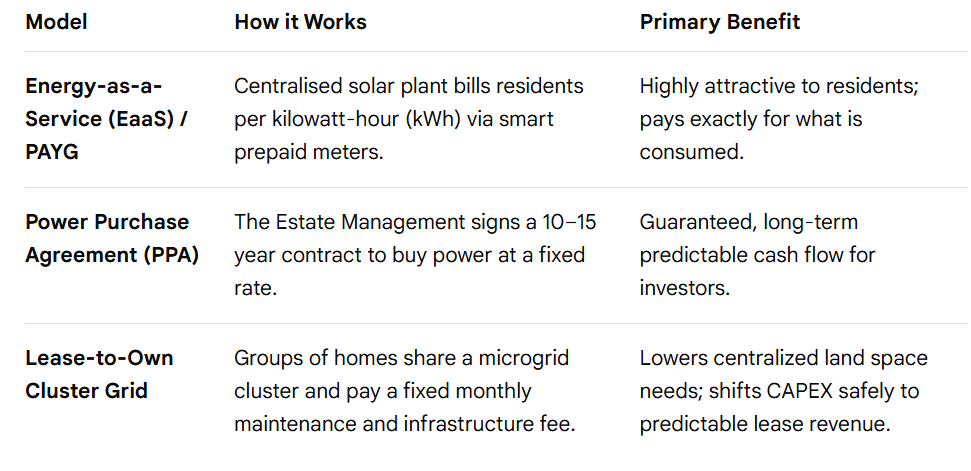
3. Business & Monetisation Models
To ensure high adoption rates within the private estate, choose or combine these models:
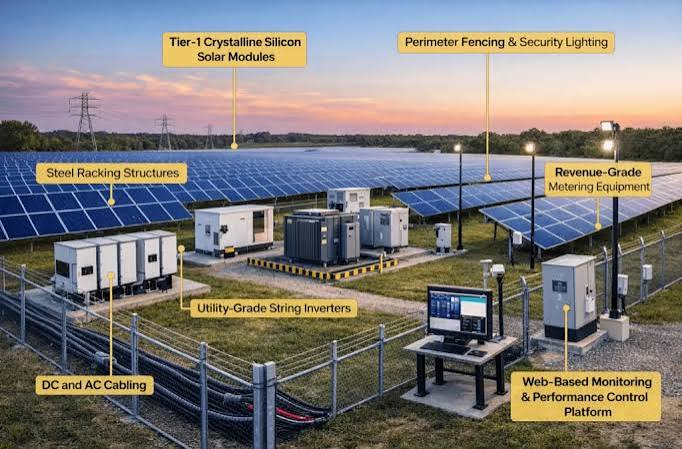
Infrastructure Design: Centralized ground-mounted solar farm on designated estate common grounds (or extensive clubhouse rooftop arrays) paired with high-capacity Lithium-ion battery storage banks.
Key Components: Tier-1 Monocrystalline solar panels, commercial hybrid smart inverters, charge controllers, underground distribution cabling, and smart automated prepaid meters.
Grid Integration: Hybrid integration with the national grid (or existing estate backup diesel generators) to act as a secondary fail-safe during extended periods of heavy monsoon rain or overcast skies.
5. Regulatory & Regulatory Compliance
Operating a utility network inside a private domain requires careful legal framing:
Entity Registration: Register with corporate legal entities (e.g., CAC in Nigeria).
Permits & Licensing: Check local regulatory commission rules (e.g., NERC mini-grid thresholds in Nigeria) to determine if your capacity requires a permit or operates under an exemption threshold.
Legal Agreements: Draft standard tripartite agreements between the Solar Provider, Estate Management Association (HOA), and Individual Residents explicitly clarifying tariff structures, access rights for maintenance, and service level agreements (SLAs).
Permitting & Licenses: Compliance with local energy sector regulators (such as NERC guidelines for mini-grids where applicable) and local building/environmental permits. [1, 2]
Estate Concession Agreement: A formal agreement or service level agreement (SLA) with the Estate Residents Association or developer granting exclusive or primary power distribution rights.
6. Financial Plan & Projections
Initial CAPEX: Panels (40%), Batteries & Inverters (45%), Distribution & Civil Works (15%).
OPEX: Quarterly operations and maintenance (O&M), panel cleaning, software licensing for smart meters, and customer service management.
Payback Period: Typically 3.5 to 5.5 years depending heavily on daytime vs. nighttime energy balance patterns within the estate.
Comments (0)
No comments yet. Be the first to share your thoughts.