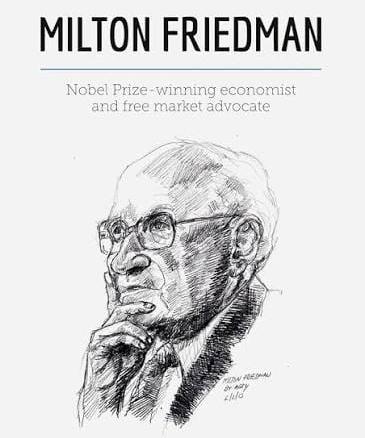
Milton Friedman (July 31, 1912 – November 16, 2006) was an American economist, statistician, and intellectual leader of the Chicago School of Economics who was awarded the 1976 Nobel Prize in Economic Sciences. He is widely recognized as one of the 20th century's most influential proponents of free-market capitalism and classical liberalism.
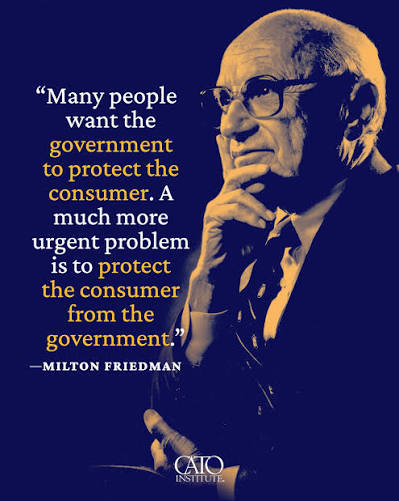
Milton Friedman : "There is no such thing as a free lunch."
"A society that puts equality before freedom will get neither. A society that puts freedom before equality will get a high degree of both."
Milton Friedman.
"a company's only social responsibility is to increase its profits for its shareholders." (Friedman)
Monetarism: Argued that "inflation is always and everywhere a monetary phenomenon" and that controlling the growth of the money supply is the primary tool for stabilizing the economy.
Permanent Income Hypothesis: Proposed in A Theory of the Consumption Function (1957), suggesting people base their consumption on their expected long-term-average income rather than current income.
Natural Rate of Unemployment: Challenged the long-run Phillips curve by demonstrating there is no permanent trade-off between inflation and unemployment.
The Friedman Doctrine (Shareholder Theory): Outlined in a 1970 New York Times essay, stating that a corporation's primary social and moral responsibility is to increase its profits for shareholders within legal and ethical bounds.
Major Works & Policy Impact
A Monetary History of the United States, 1867–1960 (co-authored with Anna Schwartz) – Blamed the Federal Reserve's severe monetary contraction for worsening the Great Depression.
Capitalism and Freedom (1962) & Free to Choose (1980) – Popularized free-market ideas for a general audience.
Policy Advocacy: Championed floating exchange rates, school vouchers, a negative income tax, deregulation, the abolition of peacetime conscription, and the end of state medical/occupational licensing. His ideas heavily influenced global economic shifts, including policies under U.S. President Ronald Reagan and British Prime Minister Margaret Thatcher.
Comments (0)
No comments yet. Be the first to share your thoughts.