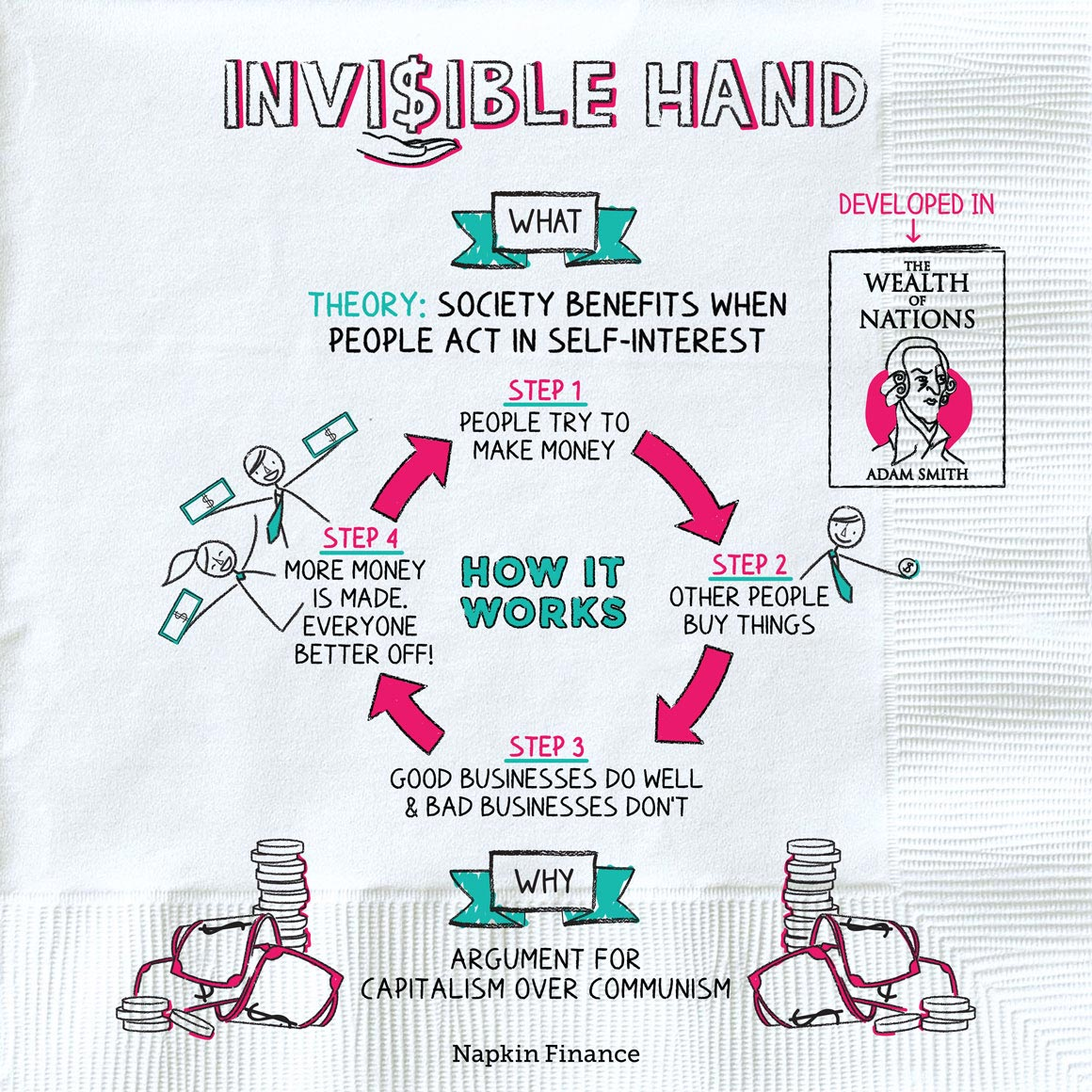
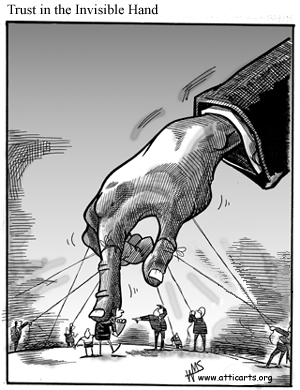
The invisible hand is a metaphor introduced by Adam Smith that describes how self-interested individuals in free markets can unintentionally benefit wider society.
"self interest govern progress"
Unintentional Benefit: A baker does not bake bread out of pure charity; they do it to make a living. However, by doing so, they provide affordable food for the community.
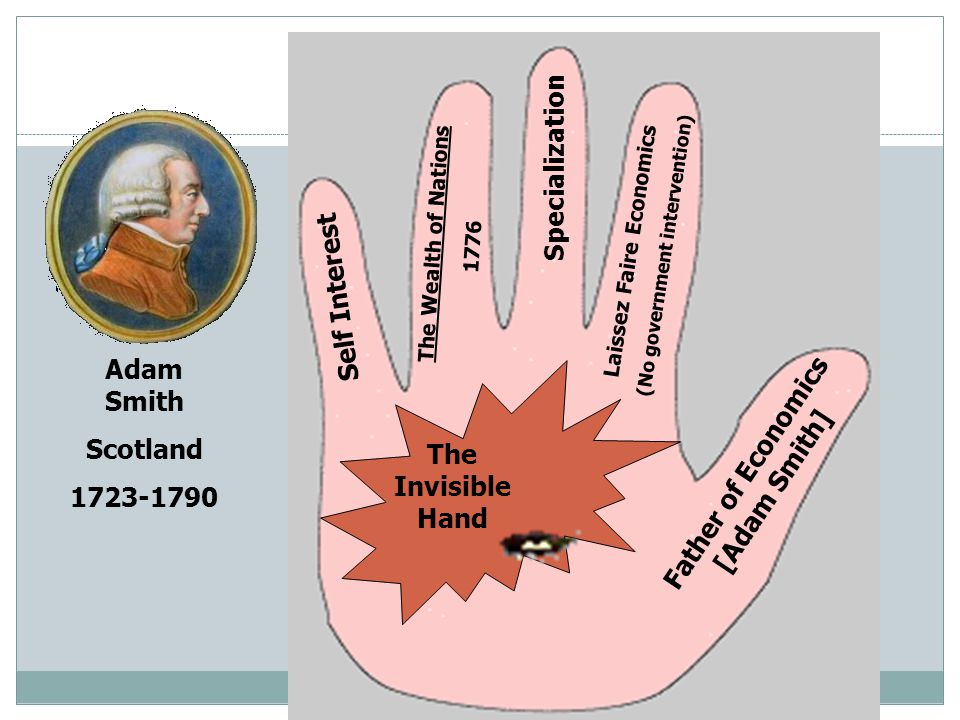
The invisible hand is a foundational economic metaphor introduced by 18th-century Scottish philosopher Adam Smith. It describes how self-interested individuals operating in a free market inadvertently promote the general welfare and economic efficiency of society
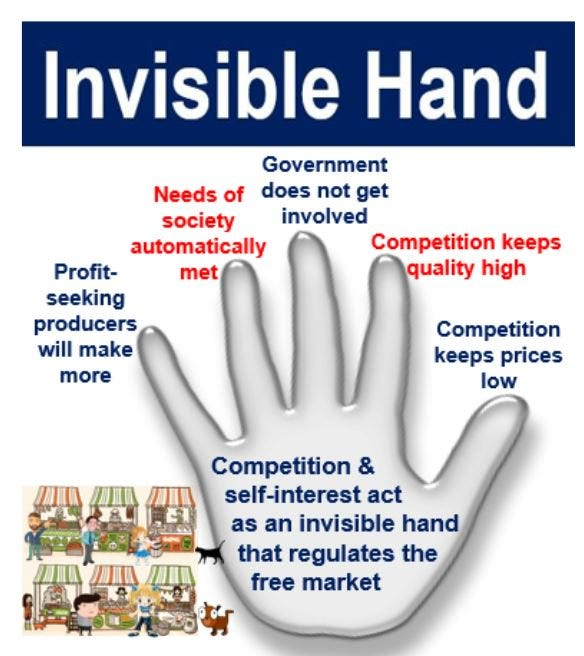
Self-Interest: People work and trade to help themselves, not others.
Unintended Benefit: This private pursuit of profit accidentally fulfills public needs, such as supplying food and goods.
Market Equilibrium: Prices and quantities balance naturally through supply and demand without needing government control.
Famous Examples
The Butcher and Baker: Smith famously noted that dinner comes from the butcher or baker's regard for their own money-making, not their kindness.
Domestic Investment: In The Wealth of Nations, Smith used the idea to show how traders promote their economic gain Invisible Hand ⚙️ How the Invisible Hand Works
The mechanism relies on two primary pillars working together:
Self-Interest Motivates: Individuals seek to maximize their own well-being. Consumers look for the best value, while business owners try to maximize profit. As Smith famously noted in The Wealth of Nations: "It is not from the benevolence of the butcher, the brewer, or the baker that we expect our dinner, but from their regard to their own self-interest."
Competition Regulates: If a business charges too much or sells low-quality goods, a competitor will step in with a better offer to win over consumers. This forces companies to lower prices, improve quality, and innovate—ultimately benefiting the whole society.
📊 The Price System as the Guide
The invisible hand manifests visually and practically through the price system. Prices act as a communication network:
High prices signal to producers that a good is in high demand, prompting them to allocate more resources to make it.
Low prices signal an oversupply, telling producers to scale back and focus on items that society actually needs.
Where Smith Used the Term
Adam Smith used the phrase "invisible hand" in only a few places across his writings: [1]
The Theory of Moral Sentiments (1759): Used to describe how wealthy landowners, driven by greed and consumption limits, accidentally distribute a share of the harvest to their workers. [1, 2]
The Wealth of Nations (1776): Used to describe why a merchant prefers investing in the domestic economy rather than foreign trade (due to lower perceived risk), thereby unintentionally supporting local industry and national wealth.
Criticisms and Limitations
Inequality: Critics point out that pure self-interest can create massive wealth gaps and leave vulnerable populations behind.
Market Failures: Monopolies, environmental pollution, and public goods often require government regulation because the invisible hand fails to manage them on its own.
Comments (0)
No comments yet. Be the first to share your thoughts.