How It's Made
How it's made : Yogurt
September 21, 2026 · 50 views ·by Odeyemi Oluwafemi
Yogurt is made by fermenting milk with helpful bacteria, which turn natural milk sugars into lactic acid to thicken the liquid and create a tangy flavor.
⇒ click for Homemade Yogurt
▶ Watch the video how it's made Yogurt
▶ Watch the video factory yogurt making process
⇒ click for Homemade Yogurt
▶ Watch the video how it's made Yogurt
▶ Watch the video factory yogurt making process
The Basic Process
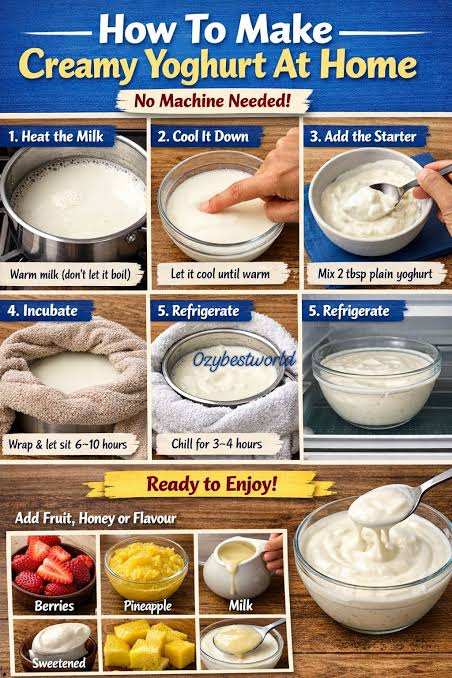
Heating: Milk is heated to around 85–90°C (185–194°F) to kill harmful bacteria and change the milk proteins so they form a solid gel later.
Cooling: The milk cools down to about 40–45°C (104–113°F), a safe temperature where the bacteria will thrive instead of dying.
Inoculation: A starter culture containing live bacteria (Lactobacillus bulgaricus and Streptococcus thermophilus) is mixed into the warm milk.
Fermentation: The mixture rests in a warm, dark place for 6 to 8 hours. The bacteria feed on lactose (milk sugar) and produce lactic acid, which lowers the pH and clots the milk into yogurt.
Cooling and Storing: The yogurt is placed in a refrigerator to stop fermentation and set the final texture.
The industrial production of yogurt transforms raw liquid milk into a thick, creamy, and tart dairy staple through a carefully controlled process of pasteurization, texturizing, and bacterial fermentation.
The industrial production of yogurt transforms raw liquid milk into a thick, creamy, and tart dairy staple through a carefully controlled process of pasteurization, texturizing, and bacterial fermentation.
Here is step-by-step breakdown of how yogurt is made on a commercial scale:
1. Standardization & Composition Adjustment.
- Testing: Raw milk arrives at the factory in refrigerated trucks and is heavily tested for quality, fat content, and contaminants.
- Separation: The milk passes through centrifugal separators spinning at high speeds to separate it into skimmed milk and heavy cream.
- Standardization: The cream and skimmed milk are re-blended in precise ratios to achieve specific fat percentages (e.g., low-fat vs. whole-milk yogurt).
- Fortification: Dry ingredients like skimmed milk powder or protein concentrates are mixed in to raise the "solids-not-fat" (SNF) content. This makes the final product structurally firmer.
2. Pasteurization & Homogenization
- Pasteurization: The milk mixture is heated to 80°C–90°C (176°F–194°F) for several minutes. This serves two purposes: it kills any competitive, unwanted bacteria, and it denatures whey proteins, which forces them to hold water and create a thicker texture.
- Homogenization: High-pressure industrial pistons crush the fat globules in the milk so they merge uniformly. This prevents the cream from naturally separating and floating to the top during storage.
3. Inoculation & Fermentation
- Cooling: The milk is cooled down to the ideal temperature for bacteria to thrive, usually between 43°C and 45°C (109°F–113°F).
- Inoculation: Workers add a freeze-dried starter culture consisting of live, beneficial bacteria—primarily Streptococcus thermophilus and Lactobacillus bulgaricus.
- Fermentation: The mixture sits undisturbed in large insulation tanks for 6 to 20 hours. During this time, the bacteria consume lactose (milk sugar) and convert it into lactic acid. This acid drops the pH of the milk, causing its proteins to coagulate and clot into a thick gel. The process also creates acetaldehyde, which gives yogurt its characteristic tangy flavor.
- 4. Cooling & Final Styling
Once the yogurt reaches the desired thickness and acidity, it is quickly cooled to stop the fermentation process. Depending on how it is handled next, factories create different styles of yogurt:- Set Yogurt: The milk is poured into the retail cups immediately after the bacteria is added, and it ferments/sets directly inside the final package.
- Stirred Yogurt: The yogurt ferments in large tanks, is gently broken up, and fruit jams, sugars, or flavorings are blended in uniformly before filling.
- Greek/Strained Yogurt: The yogurt is mechanical pumped through ultrafiltration systems or centrifuges to strain out the liquid whey, resulting in a much denser, protein-rich product.
- 5. Packaging
Automated packaging lines form plastic cups, wrap them in labels, fill them with yogurt under sterile, filtered-air conditions to avoid contamination, and heat-seal aluminum lids onto the tops.
Comments (0)
No comments yet. Be the first to share your thoughts.