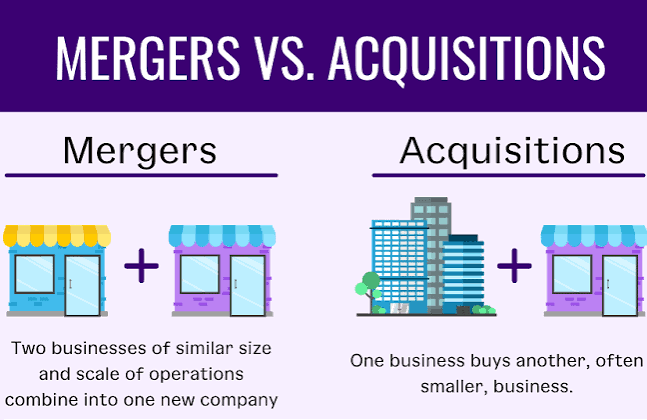
Mergers and acquisitions (M&A) refer to the joining of two companies. A merger unites two equal firms into a new single brand, while an acquisition involves a larger buyer purchasing a smaller target business. Both strategies aim to increase market power, cut costs, and accelerate growth.
Mergers and acquisitions (M&A) represent the consolidation of companies or assets through various financial transactions, typically aimed at achieving strategic growth, operational synergies, or market expansion.
Because you asked a broad query, this overview assumes you are looking for a foundational understanding of thestrategic drivers, transaction phases, and structural risksinvolved in corporate M&A.
Core Concepts of M&A
Merger: Two firms of similar size join forces to create a brand-new company.
Acquisition: One larger company buys a target company, absorbing its operations.
Synergy: The core financial goal where the combined company is worth more than the separate parts.
Due Diligence: The deep review process before a deal closes.
Main Types of M&A Deals
Horizontal: Companies in the same industry combine to grow market share.
Vertical: Companies at different steps in a supply chain join together.
Conglomerate: Totally unrelated businesses unite to diversify.
Hostile Takeover: A buyer forces a purchase against the target board's wishes.
Organizational Growth Organizational growth through mergers and acquisitions (M&A) is a structured strategy used to accelerate scale, expand capabilities, enter new markets, and achieve synergies that would be slower or more costly through internal development. The process typically begins with strategic fit and target screening, followed by due diligence covering financial performance, legal and regulatory exposure, operational efficiency, technology and intellectual property, customer concentration, and cultural compatibility. Deal structuring then determines how value is transferred—through cash purchases, stock-for-stock exchanges, earn-outs, or mixed consideration—while governance and integration planning are established early to reduce execution risk. Financially, acquirers evaluate expected returns using valuation methods such as discounted cash flow and comparable transactions, and they model synergy realization (cost reductions, revenue enhancements, procurement leverage, and cross-selling) alongside integration costs, one-time charges, and potential dilution or leverage impacts. Operationally, successful integration requires aligning systems and processes (ERP, CRM, HR, reporting), consolidating supply chains, standardizing controls, and retaining key talent; cultural integration is often as critical as technical integration to prevent productivity loss and customer churn. Regulatory approvals—antitrust review, industry-specific licensing, and foreign investment scrutiny—can affect timing and deal terms, while post-merger performance is monitored through integration milestones, synergy tracking, and risk management. Common failure modes include overpaying, underestimating integration complexity, insufficient diligence on liabilities, and neglecting change management, all of which can erode shareholder value. When executed with disciplined valuation, rigorous diligence, and a clear integration roadmap, M&A can provide durable growth by combining complementary assets and capabilities into a more competitive and resilient organization.

Comments (0)
No comments yet. Be the first to share your thoughts.