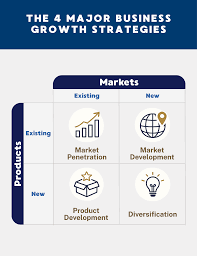
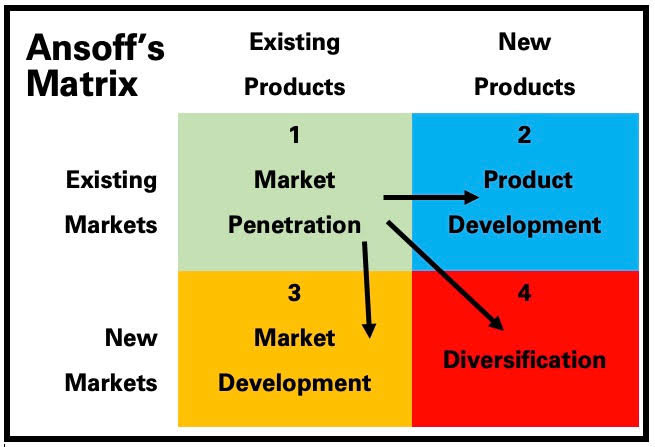
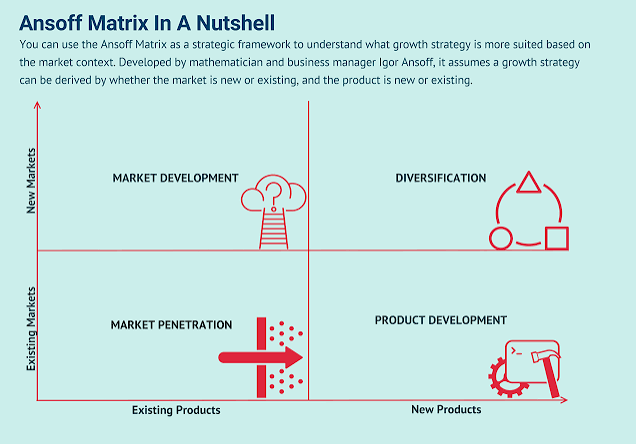
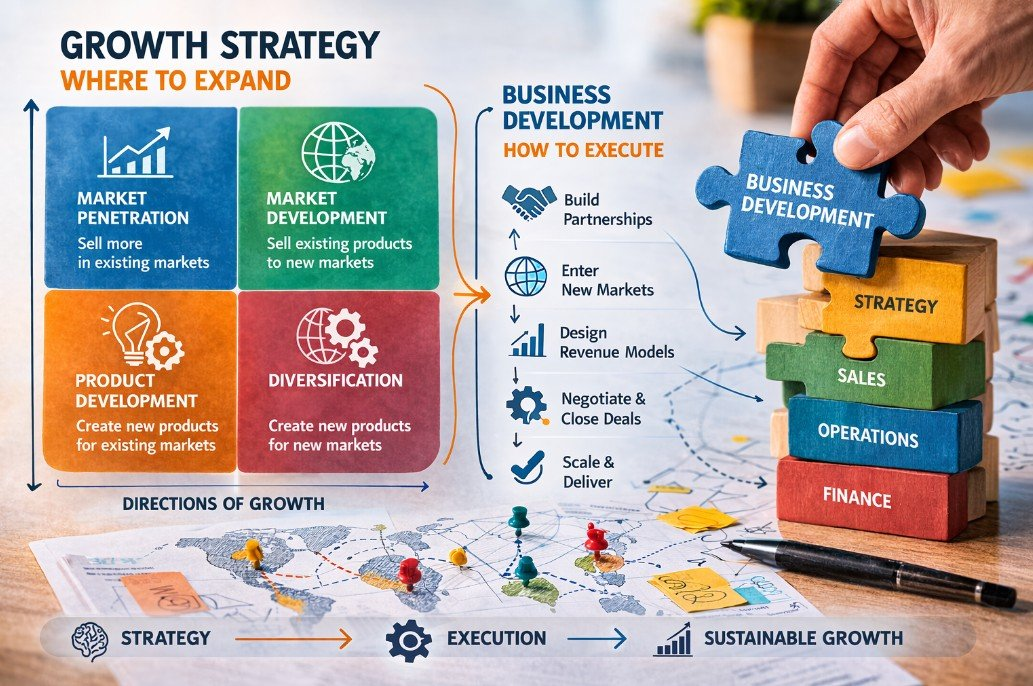
Market Expansion (Development): Taking existing products and entering new customer segments or geographic regions. This requires localization and research, but avoids the cost of building new items. [1, 2, 3]
Product Expansion (Development):Launching new features, services, or products to your current customer base. This deepens loyalty and increases revenue through upselling.
Market Penetration:Increasing your market share in current markets with existing products through better marketing or service.
Diversification: Entering new markets with completely new products. This offers high rewards, but carries the highest risk.
Key Steps to Execute
Analyze Your Base: Evaluate your current sales, customer feedback, and operational capacity.
Choose Your Focus:Decide if your next phase needs new customers or new products.
Test and Track: Run small pilot programs and measure key performance indicators (KPIs) before a full rollout.
Organizational growth is primarily driven by balancing two core strategic levers: market expansion (finding new customers) and product expansion (offering new solutions). When businesses look to scale, they evaluate these options using the classic Ansoff Matrix, a framework that maps growth opportunities based on whether the product and market are current or brand new. Choosing between these paths—or combining them—depends on your risk tolerance, current market penetration, and research and development (R&D) capabilities. Ansoff's Matrix 🗺️ Market Expansion
Core Definition | Taking your existing products into entirely new markets or customer segments. Primary Goal | Broaden your customer base horizontally. Growth Vectors | Geographic moves, new demographics, or alternative industry verticals. Major Risk | Operational friction, legal/compliance hurdles, and lack of local brand awareness. Operational Focus | Localization, new go-to-market strategies, and cross-border logistics.
📦 Product Expansion
Core Definition | Introducingnew or modified productsto yourexisting market. Primary Goal | Deepen customer relationships and increase value vertically. Growth Vectors| Feature updates, product line extensions, or bundled offerings. Major Risk| High R&D costs, delayed product launches, and potential failure to hit product-market fit. Operational Focus| Agile engineering, innovation, customer feedback loops, and R&D.
🚀 Implementing a Market Expansion Strategy
Market expansion is ideal when your domestic or current market is reaching saturation, but your core product remains highly competitive. To execute this successfully, organizations typically follow a systematic go-to-market framework:
Target New Geographies: Scaling regionally, nationally, or internationally (e.g., a U.S. software firm establishing operations in Europe).
Shift Demographics: Re-packaging the marketing and positioning to appeal to a completely different age bracket, income level, or gender.
Adapt and Localize: Modifying language, messaging, pricing structures, and compliance standards to seamlessly integrate into the new region.
Choose Entry Methods: Deciding between lower-risk digital exports, strategic alliances with local partners, franchising, or direct acquisitions.
💡 Implementing a Product Expansion Strategy
Product expansion capitalizes on established brand trust. Because it targets customers who already buy from you, the cost of customer acquisition (CAC) is dramatically lower. Growth via product innovation requires a deep focus on utility:
Iterate with Innovation: Building upgraded versions or adding highly requested features that solve adjacent customer problems.
Introduce Product Lines: Launching complementary goods to cross-sell to the same user base (e.g., an email marketing company adding an integrated CRM tool).
Package and Bundle: Combining separate services into high-value suites to maximize average order value (AOV) and customer lifetime value (LTV).
Deploy Re-Segmentation: Building tiers of the product—like "Lite" or "Enterprise" versions—to squeeze more efficiency out of the existing base.
When an organization pursues both market and product expansion simultaneously, it enters the realm of diversification. This means launching entirely new products into completely uncharted markets.
While it holds the highest potential for massive, multi-national organizational scaling, it is also the most resource-intensive and risk-heavy growth model because the business lacks both product familiarity and historical customer data.
Comments (0)
No comments yet. Be the first to share your thoughts.