capture the spirit of curiosity, trial, and the pursuit of new knowledge. "Research is formalized curiosity. It is poking and prying with a purpose." — Zora Neale Hurston "Research is creating new knowledge." ( Neil Armstrong)
"Unless you try to do something beyond what you have already mastered, you will never grow.
Research and Development. It refers to the set of innovative activities undertaken by businesses, governments, or organizations to create new products, services, or processes, or to improve existing ones. ⇒why R and D ▶ Watch the video types of R and D
Key Components of R&D
Research: Exploring new scientific or technical knowledge without an immediate commercial goal, or using existing knowledge to solve specific, practical problems.
Development: Taking that gathered knowledge and turning it into tangible, marketable items, prototypes, or refined operational processes. prediction is the essence of research
Why R&D Matters
Driving Innovation: It serves as the core engine for new technologies and product evolutions (such as moving from basic cell phones to modern smartphones).
Competitive Advantage: Companies use R&D to stay ahead of market competitors and build offerings that are difficult to replicate.
Long-Term Growth: While it involves financial risk and does not offer an immediate financial payoff, successful R&D can lead to patents, increased productivity, and lasting profitability
R&D stands for Research and Development. It refers to the systematic process where corporations, governments, or institutions invest time and money to discover new knowledge, innovate, and develop new products, services, or processes.
At its core, R&D is the engine that drives business innovation and long-term economic growth. Research and Development
🔎 The Three Pillars of R&D
According to standard business and scientific frameworks, R&D is broken down into three distinct, chronological phases:
1. Pure / Basic Research: Focuses on gaining a fundamental understanding of scientific principles or phenomena. There is no immediate commercial goal or product in mind (e.g., studying how a specific virus mutates).
2. Applied Research: Takes that fundamental knowledge and targets it toward a specific, practical problem. The objective shifts toward finding a real-world solution (e.g., trying to use the virus mutations to create a target vaccine formula).
3. Development: Translates the findings of applied research into commercial products, services, or manufacturing processes. This involves building prototypes, testing, and refining the concept before it goes to market.
Because R&D deals with scientific or technological uncertainty, it functions very differently from other business operations:
High Capital Risk: Companies commit massive amounts of upfront capital with no guarantee of an immediate payoff or a return on investment (ROI). Many R&D projects end in failure.
Intellectual Property (IP): When R&D is successful, it allows companies to secure valuable patents, copyrights, and trademarks. This creates a massive legal barrier that prevents competitors from replicating their technology.
Market Relevance: In rapidly shifting sectors like technology and healthcare, neglecting R&D means a company quickly becomes obsolete as competitors launch more advanced solutions.
While we often associate R&D with lab coats and high-tech software, it spans almost every sector:
Pharmaceuticals: Spending billions over a decade to discover, synthesize, and clinically test a single life-saving drug.
Technology & AI: Developing large language models, refining microchip efficiency, or testing autonomous driving algorithms.
Automotive: Designing lighter materials, inventing higher-capacity electric vehicle batteries, or improving aerodynamics.
Consumer Goods: Formulating plant-based meat alternatives that match the texture and taste of real beef.
Core Benefits and Challenges
Competitive Advantage: Yields unique offerings that are difficult for competitors to replicate.
Long-Term Growth: Sustains profitability and market relevance over time.
Financial Risk: Involves high upfront costs with no guarantee of an immediate return on investment.
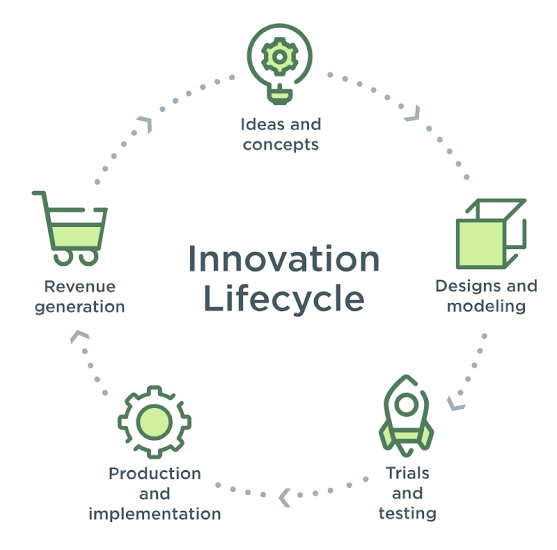
innovation Cycle Research and Development (R&D) is the systematic activity undertaken to generate new knowledge and translate it into improved products, processes, or services. It typically includes basic research (to expand scientific understanding without immediate commercial objectives), applied research (to solve specific practical problems), and experimental development (to prototype, test, and refine solutions for technical feasibility, performance, reliability, and manufacturability). Effective R&D management requires clear problem statements, measurable technical objectives, defined hypotheses, rigorous methods for experimentation and validation, and structured documentation to support reproducibility and regulatory or quality requirements. Key outputs include validated technical concepts, prototypes, process improvements, patents or other intellectual property, technical data packages, and evidence supporting scale-up and cost reduction. R&D is commonly governed by stage-gate or portfolio management approaches that balance expected value against technical risk, timeline, and budget constraints, with decisions informed by metrics such as technical milestones, cost-to-test, failure rates, time-to-prototype, and downstream impact on revenue, safety, or compliance. In many industries—such as pharmaceuticals, semiconductors, aerospace, automotive, and software—R&D is also tightly linked to cross-functional engineering, supply chain considerations, and field or customer feedback to ensure that innovations meet real-world requirements.
Comments (0)
No comments yet. Be the first to share your thoughts.



Comments (0)
No comments yet. Be the first to share your thoughts.