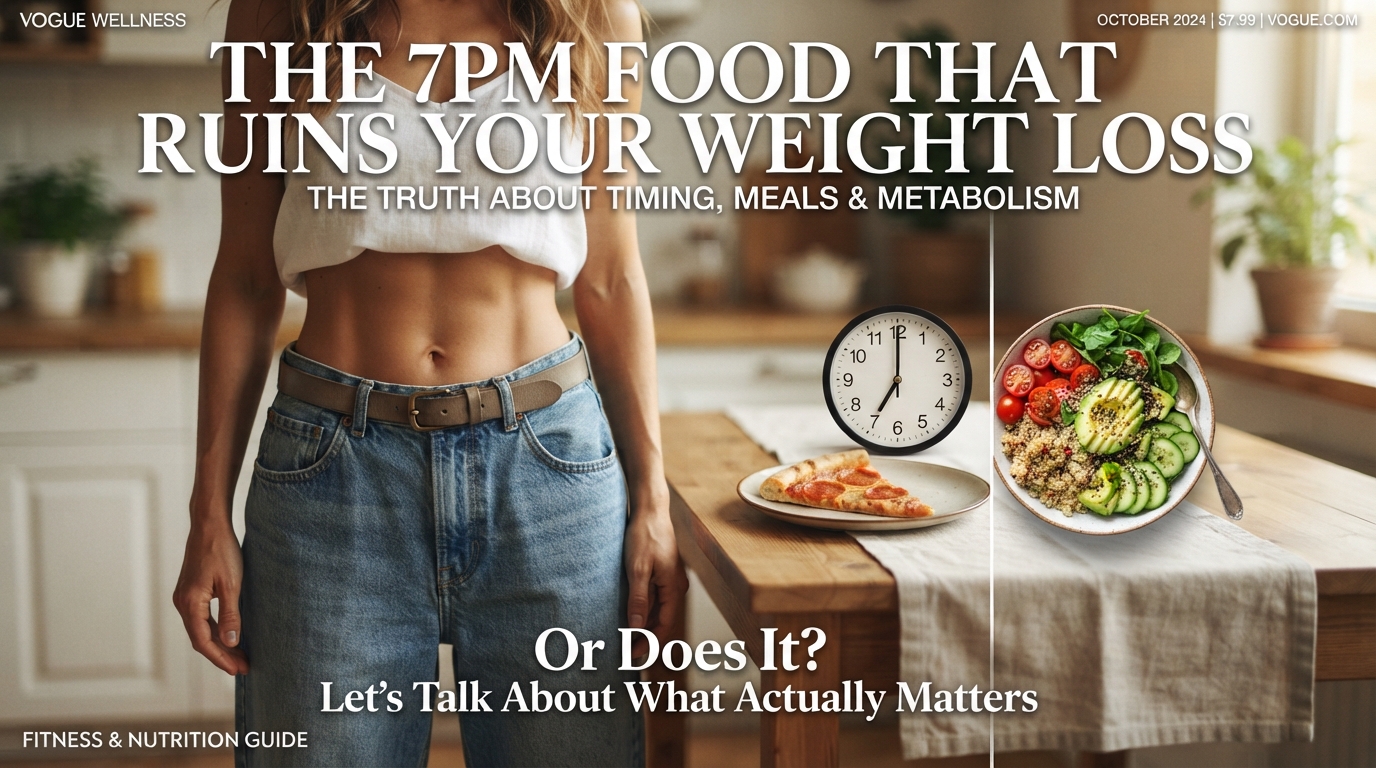
THE 7PM FOOD THAT RUINS YOUR WEIGHT LOSS Or Does It? Let's Talk About What Actually Matters
“Don't eat after 7 PM.”
You've probably heard this advice at least once.
Maybe someone told you that eating late automatically causes weight gain.
Maybe you've skipped dinner because you were afraid of ruining your progress.
Maybe you've been sitting on your bed at 9 PM, hungry, staring at the clock and thinking:
“Well... I guess I'm not eating today.”
But here's the interesting question:
Does your body actually know it's 7 PM?
Or have we been giving the clock far too much power?
THE IDEA OF THE “DANGEROUS” HOUR
Weight-loss culture loves simple rules.
Don't eat after 7.
Don't eat carbs.
Never eat rice.
Don't eat at night.
Cut sugar completely.
Skip breakfast.
Eat only once a day.
The problem is that simple rules can make complicated things sound incredibly easy.
But your body doesn't operate according to a single magic number.
Weight management is influenced by a combination of factors, including overall food intake, activity, sleep, eating patterns and individual circumstances.
So eating a meal at 7:30 PM doesn't automatically transform it into body fat.
SO WHY DOES LATE-NIGHT EATING GET BLAMED? WHAT'S TO BLAME. Because late-night eating can sometimes be connected with other habits.
Picture this:
It's 10 PM.
You're tired.
You've been working all day.
You're watching something on your phone.
You aren't exactly hungry, but you're bored.
There's a packet of biscuits nearby.
You eat one.
Then another.
Then you think:
“Since I've already started...”
And suddenly the entire packet is gone.
The issue wasn't necessarily that you ate at 10 PM.
The bigger issue was mindless eating.
HUNGER OR HABIT?
This is a question worth asking yourself.
Are you eating because your body genuinely needs food?
Or because you're bored?
Stressed?
Lonely?
Tired?
Celebrating?
Scrolling?
Watching a movie?
Sometimes food becomes connected to emotions and routines.
You don't necessarily think:
“I'm going to eat because I'm emotionally overwhelmed.”
You simply find yourself in the kitchen.
Understanding your habits doesn't mean judging yourself.
It means becoming more aware of them.
FOOD DOESN'T HAVE TO BECOME YOUR ENEMY IS IT YOUR ENEMY? One of the biggest problems with extreme dieting is that it can make people afraid of food.
Suddenly, everything becomes a battle.
Rice is bad.
Bread is bad.
Dinner is bad.
Dessert is bad.
Eating after a certain time is bad.
And eventually, food becomes associated with guilt.
But food isn't the enemy.
Your body needs nourishment.
The goal of healthy weight management isn't to spend your entire life terrified of eating.
It's to develop patterns that support your health and that you can realistically maintain.
THE PROBLEM WITH EXTREME RESTRICTION
Imagine telling yourself:
“I'm never eating after 7 PM again.”
You follow the rule for three days.
Then one evening you're genuinely hungry.
You eat.
Now you feel like you've failed.
So you think:
“I've already ruined it.”
And because you believe the entire plan is broken, you abandon it.
This is one reason overly rigid rules can become difficult to maintain.
A sustainable approach doesn't require perfection.
It requires consistency.
WHAT ACTUALLY MATTERS?
Instead of obsessing over one particular hour, consider the bigger picture.
What does your overall diet look like?
Are your meals generally balanced?
Are you eating enough nutritious foods?
Are you regularly physically active?
Are you getting enough sleep?
Are you constantly eating when you're stressed or bored?
Are your portions appropriate for your needs?
Are your habits realistic enough to maintain?
Those questions are far more useful than simply asking:
“Did I eat after 7?”
BUT WHAT IF YOU'RE ACTUALLY HUNGRY? SHOULD YOU STARVE? Being hungry doesn't mean you've failed.
Sometimes you're simply hungry.
And instead of treating hunger like an enemy, it can be useful to understand why it's happening.
Maybe you didn't eat enough earlier.
Maybe your schedule changed.
Maybe you're more physically active that day.
Maybe you simply need food.
There's no universal rule that says your body must stop needing nourishment because the clock passed a particular hour.
DON'T LET WEIGHT LOSS BECOME A PUNISHMENT IT'S NOT MEANT TO BE RIGID. Wanting to manage your weight can be a perfectly reasonable health goal.
But you shouldn't have to hate yourself to achieve it.
You don't need to punish yourself for eating.
You don't need to feel guilty every time you enjoy food.
You don't need to turn every meal into a mathematical equation.
And you definitely don't need to believe that one late meal has destroyed everything.
Health is bigger than a single meal.
And your body is more complicated than a clock.
SO... IS 7 PM REALLY THE PROBLEM?
Not necessarily.
The bigger picture matters much more than one magical cutoff time.
If eating late becomes a regular pattern of excessive snacking or disrupts your sleep, that's something worth paying attention to.
But “I ate after 7 PM” isn't automatically the explanation for someone's weight.
So the next time someone tells you:
“Never eat after 7.”
Don't panic.
Ask a better question:
“What does my overall lifestyle look like?”
Because sustainable weight management isn't about finding one magical hour when food suddenly becomes forbidden.
It's about understanding your habits, taking care of your body and finding an approach you can actually live with.
The clock isn't your enemy.
And your dinner isn't automatically your downfall.
Comments (0)
No comments yet. Be the first to share your thoughts.



Comments (0)
No comments yet. Be the first to share your thoughts.