Business Ideas & Implementation
Business : Warehouse, Good Retirement Plan
June 30, 2026 · 25 views ·by Odeyemi Oluwafemi
Building a warehouse and a storage facility close to the city or commercial hub:
"Fast is fine, but accuracy is everything " (Wyatt Earp)
"Good actions give strength to ourselves and inspire good actions in others." (Plato)
"We have to act on our knowledge " ( Dr David Archer)
▶ Watch the video storage facility in India
▶ Watch the video economics of owing a Warehouse
"Fast is fine, but accuracy is everything " (Wyatt Earp)
"Good actions give strength to ourselves and inspire good actions in others." (Plato)
"We have to act on our knowledge " ( Dr David Archer)
▶ Watch the video storage facility in India
▶ Watch the video economics of owing a Warehouse
Owning commercial warehouse real estate provides a strong retirement plan through tangible asset appreciation and reliable passive rental income
Building a warehouse typically pays for itself in 4 to 12 years compared to renting, depending on localized Nigerian real estate rates.
When deciding whether to build or lease a commercial storage space, you must weigh immediate capital expenditure against long-term operational costs.
A warehouse business can serve as an exceptional retirement vehicle, offering a powerful combination of predictable cash flow, long-term equity growth, and significant tax advantages. However, transforming industrial real estate into a hands-off, secure retirement fund requires moving strategically from an active operational model to a passive asset management framework.
A warehouse business can serve as an exceptional retirement vehicle, offering a powerful combination of predictable cash flow, long-term equity growth, and significant tax advantages. However, transforming industrial real estate into a hands-off, secure retirement fund requires moving strategically from an active operational model to a passive asset management framework.
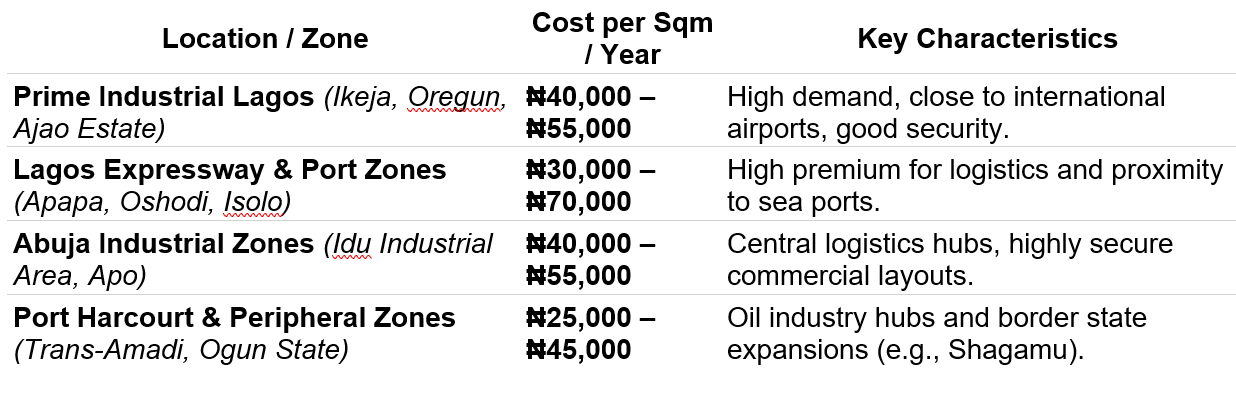
on average, renting a standard commercial warehouse costs between ₦25,000 and ₦70,000 per square meter, per year, while building a basic warehouse costs between ₦160,000 and ₦300,000 per square meter.
Asset Appreciation & Depreciation: Owning a warehouse provides a depreciable physical asset for tax purposes while the underlying land generally appreciates over time in major Nigerian commercial hubs like Lagos (Ogun axis, Lekki, Apapa) or Kano/Portharcourt.

🔨 Cost to Build a Warehouse (Construction)
If you choose to construct your own facility, structural engineering firms like JECCL estimate the following build costs per square meter:
- Standard Storage Shed (Mild Steel Truss / Galvalume): ₦150,000 – ₦200,000 / sqm
- Reinforced Industrial Factory / Heavy Machinery Depot: ₦200,000 – ₦300,000 / sqm
- Specialized Cold Storage / Temperature-Controlled Warehouse: ₦300,000 – ₦500,000 / sqm
(Note: These figures exclude land acquisition, civil approvals, and internal racking systems).
💰 Cost to Buy an Outright Warehouse
Purchasing complete structures on platforms like Nigeria Property Centre like jiji.ng typically translates to ₦500,000 to ₦1,200,000 per square meter of built-up area.
- For example, a 2,000 sqm warehouse in Maryland, Lagos commands roughly ₦1.6 Billion.
- A 7,300 sqm warehouse in Oregun, Ikeja averages ₦5.5 Billion.
How to build cheap but strong (for more info. contact evionis series ltd (evionis.ng):
whether you buy in the city or village cost of materials will probably be the same.
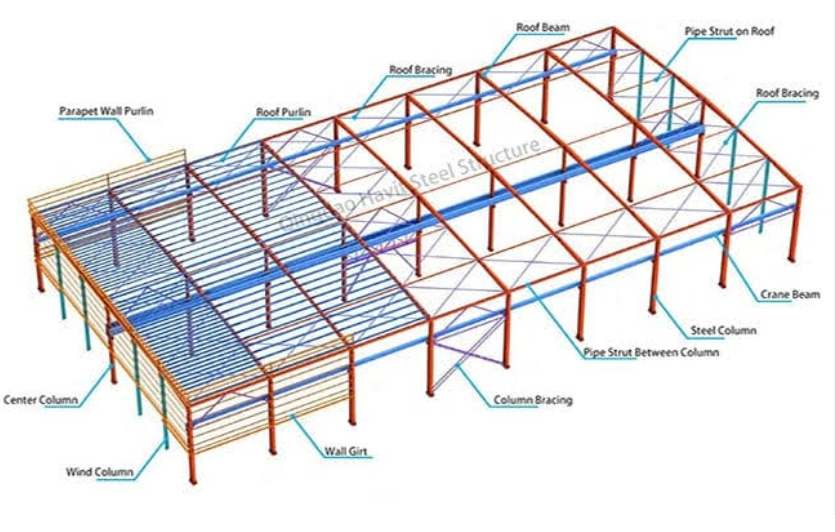
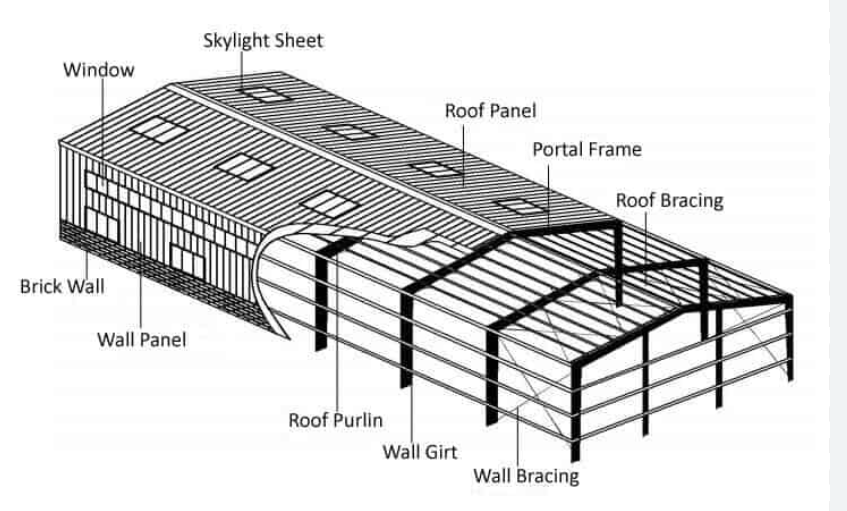
Buy H beams yourself after you get the dimensions from the structural drawings (see portal frame pictures.
Mold your blocks yourself by employing direct laborers. where the trade union are molding 45 blocks to a bag, you mold 25 blocks to bag, it will land at same cost as buying inferior blocks as yours will be stronger. You will need about 5000 blocks for a 18meter by 40 meter and 6 meter portal frame warehouse.
Get a civil engineer to do the foundation for you by using laser equipment to precisely position all foundation beams' bolts on the H beams short pillars.
Get a qualified mechanical engineer to fabricate the portal frame for you from the H beams, bars etc. you purchased and installed for you.
finally you do the floor using direct labors and standard industrial concrete mixture
use direct labors for formwork setting of the blocks
use atleast 0.75mm to 1mm aluminum roofing sheet, ensure to buy this yourself by visiting the factory and using your venier caliper to check the thickness gauge as claimed by the supplier.
all other fittings can be installed by those who want to rent from u....
📊 Strategic Warehouse Investment Framework
🏢 Small-Bay Industrial / Flex Space
- How it works: Multi-tenant units for local contractors or e-commerce.
- Pros: High local demand, lower vacancy risk with diverse tenants.
- Cons: Requires active property management or hiring a firm.
- Financial proxy: Purchase cost of $500,000 yields ~$4,500 monthly gross rent.
📦 Self-Storage Facilities
- How it works: Automated or low-staff compartment rentals.
- Pros: Minimal upkeep, straightforward tenant turnover.
- Cons: High initial land acquisition and security infrastructure costs.
Financial proxy: 50-unit facility returning steady monthly cash flow with low labor overhead.
🚛 Logistics / Vehicle Parking Yards
- How it works: Fenced outdoor hardstand for trucks, containers, or equipment.
- Pros: Extremely low construction and maintenance costs.
- Cons: Sensitive to municipal zoning and transportation corridor proximity.
- Financial proxy: Low capital entry with high gross lease margins on commercial transport assets.
Risk & Wealth-Degrading Factors
Total Capital Loss: Real estate values can drop during severe regional economic downturns.
Illiquidity: Commercial property cannot be sold instantly in an emergency.
Hidden Costs: Watch out for vacant transition periods, property taxes, structural repairs, and roof replacements.
( All cost is as at the time of publication and research in June 2026. Exchange rate and negotiating power is a determinant)
for specification of warehouse steels and construction visit : https://havitsteelstructure.com/portal-steel-frame-buildings/ and www.evionis.ng
➡️ Strategic Retirement Routes: Active vs. Passive
To use a warehouse for retirement, you must decide how involved you want to be. Both paths offer different lifestyles and risk profiles.
- Option 1: The Triple-Net (NNN) Leased Property (Highly Passive)
- Why it works: You lease the entire building to a single, established corporate tenant (e.g., a regional distributor). Under a Triple-Net lease, the tenant agrees to pay all building expenses, including real estate taxes, building insurance, and maintenance.
- Retirement fit: Excellent. It functions similarly to a high-yield bond but retains real estate equity. You simply collect checks with minimal landlord responsibilities.
- Option 2: Active Third-Party Logistics (3PL) Business (High Risk / High Return)
- Why it works: Instead of just renting out the space, you operate a fulfillment or pallet storage business inside it. You charge clients for inventory management, handling fees, and square footage.
- Retirement fit: Poor for lifestyle, great for an exit lump-sum. This is a grueling, active business. It works for retirement only if you build up the operations today and plan to sell the business and real estate as a bundled package to a competitor when you retire.
⚠️ Hidden Costs & Risk Guardrails
While warehouse investments are highly stable compared to multi-family residential housing, failing to account for specific structural risks can degrade your retirement wealth.
- Tenant Concentration Risk: If a single tenant occupies your warehouse and goes bankrupt, your retirement income drops to zero instantly. You must hold an emergency cash reserve equal to at least 6 to 12 months of mortgage payments to handle unexpected vacancies.
- Capital Expenditures (CapEx): While NNN leases cover basic maintenance, massive structural failures—like replacing a commercial roof or repaving a heavy-duty semi-truck parking lot—often fall back on the owner.
- The Obsolescence Factor: Modern logistics tenants demand clear ceiling heights of 24–36 feet and multiple loading docks. Buying a cheap, historic warehouse with low ceilings (under 16 feet) could leave you with an unrentable asset in 10 years.
Comments (0)
No comments yet. Be the first to share your thoughts.