Education
WHY DO SOME COUNTRIES TEACH DIFFERENTLY?
October 14, 2026 · 3 views ·by Emma-Golden
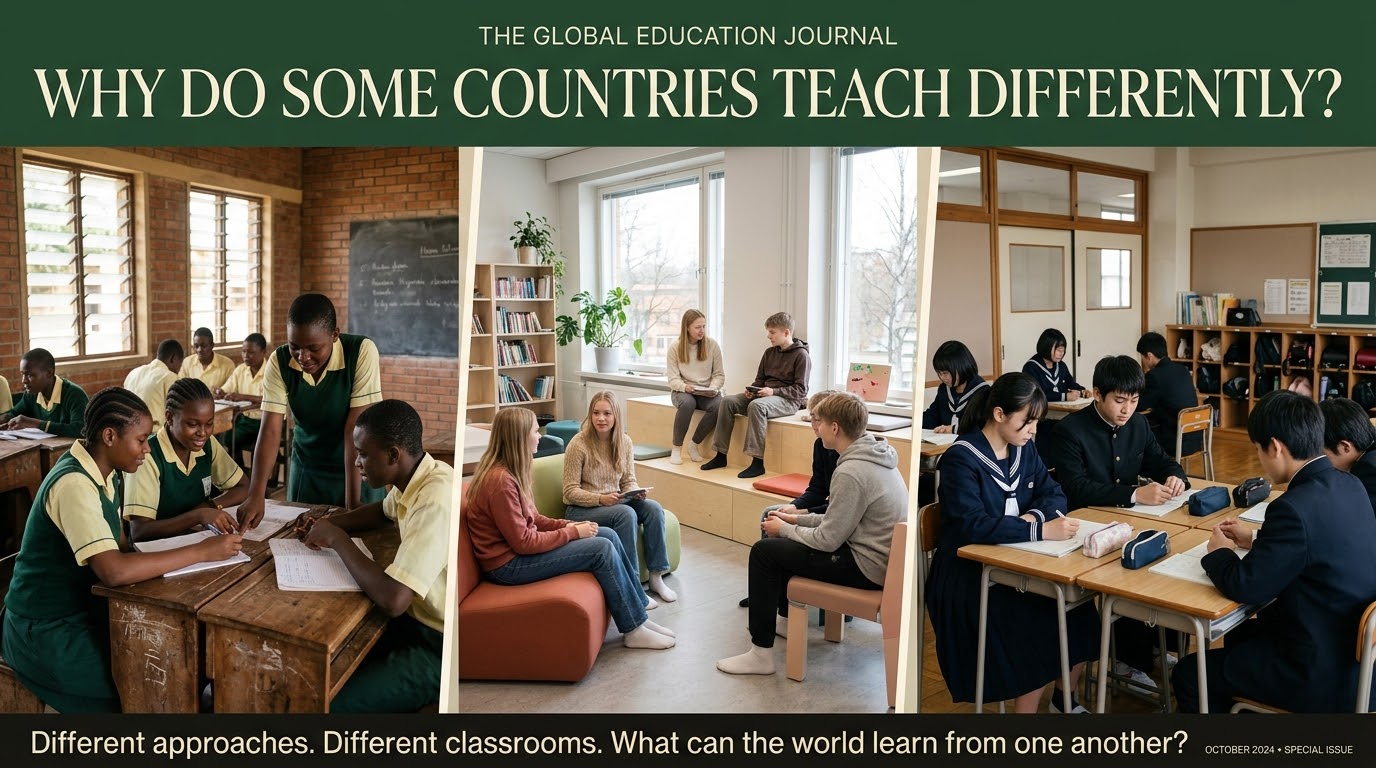
WHY DO SOME COUNTRIES TEACH DIFFERENTLY?
Imagine a student in Nigeria preparing for a major examination, another in Finland participating in a lesson built around discussion, and a student in Japan learning alongside classmates through structured group activities. Although all three are receiving an education, their everyday school experiences may look very different.
Why?
Education systems are shaped by several factors, including a country's history, culture, economic priorities, available resources, and beliefs about how children learn best.
In some systems, examinations play a major role in determining academic progress and future opportunities.
In others, schools may place greater emphasis on continuous assessment, independent projects, classroom participation, or practical problem-solving. In reality, most countries use a combination of these approaches, but the balance differs.
In others, schools may place greater emphasis on continuous assessment, independent projects, classroom participation, or practical problem-solving. In reality, most countries use a combination of these approaches, but the balance differs.
For example,
Finland is widely associated with teacher professionalism and an emphasis on student well-being.
Japan is known for structured classroom routines and collective responsibility,
while Nigeria's education system operates across diverse public and private schools, with considerable differences in resources and learning conditions.
These examples are not proof that one country has discovered a perfect model. Every system has strengths and challenges, and experiences can differ significantly between schools within the same country.
The bigger question is what each system can learn from another.
Countries seeking to improve education can examine successful approaches elsewhere, from vocational training and teacher development to digital learning and practical classroom activities. However, copying another country's system without considering local circumstances may not produce the same results.
A programme that works well in one setting may require different funding, teacher preparation, infrastructure, or cultural adjustments to succeed somewhere else.
For students, understanding these differences also broadens their perspective. It encourages them to see education as something societies can continually improve rather than a fixed system that must remain unchanged.
Ultimately, the goal should not be to make every classroom in the world look identical. It should be to ensure that learners, regardless of where they live, have meaningful opportunities to develop knowledge, useful skills, and the confidence to face the future.
Different countries may take different routes to education, but the real measure of success is whether learning equips people to build better futures.
Comments (0)
No comments yet. Be the first to share your thoughts.